
Win differently
Your reps are good. So are the reps wearing a different logo.
Sharpening the team is important, but it does not always produce better results because the competition is sharpening too. When competence is the baseline, it no longer decides the outcome. We help sales and enablement teams create a difference buyers can feel through live sessions built around the deals they are pursuing right now.
Want a read on where the team stands first? Take the diagnostic →
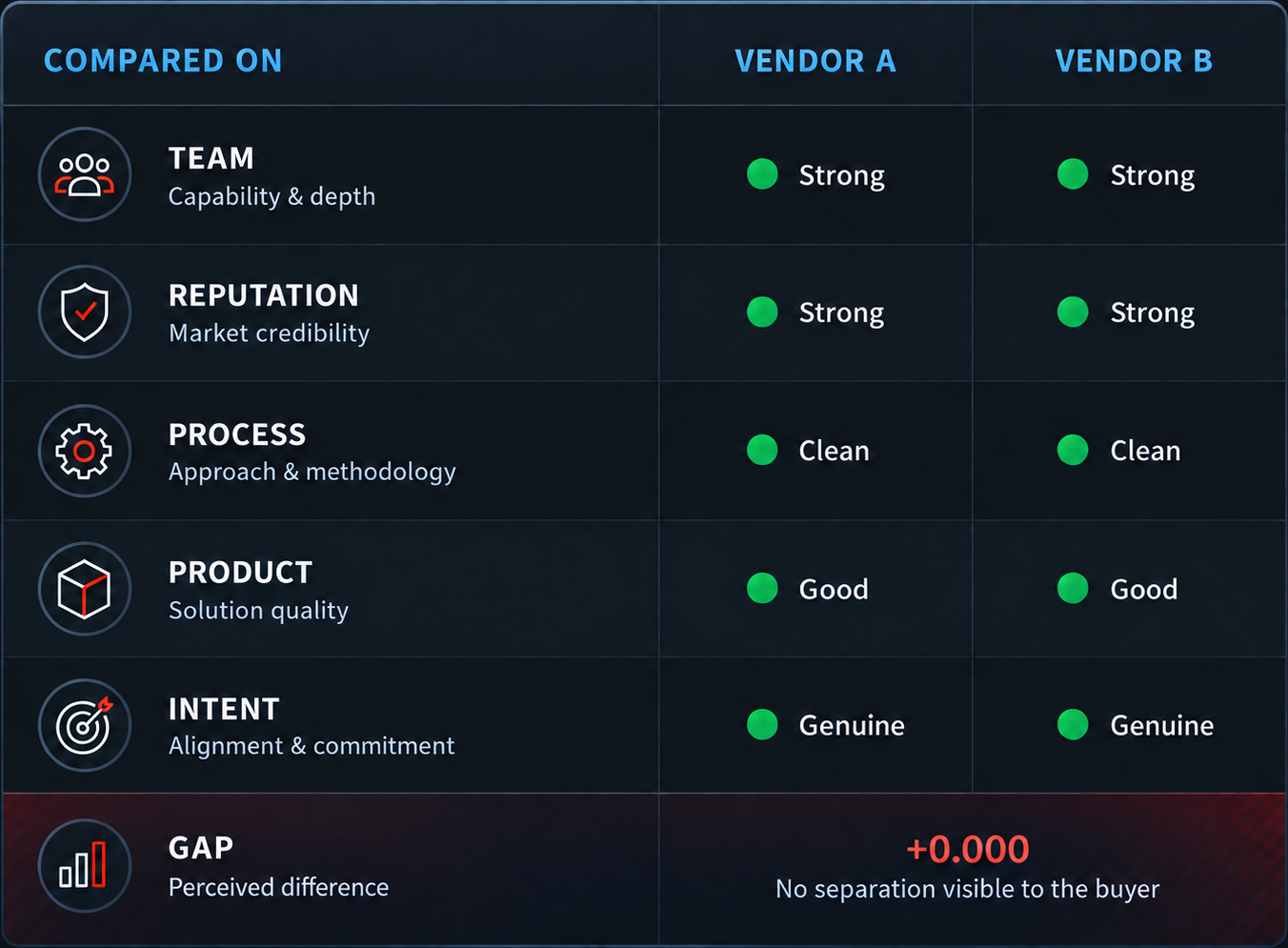
Two capable vendors. One number left to decide on.
Most sales training assumes the problem is skill. Skill is worth building, and it is rarely what decides this. Two vendors walk into the same deal, both competent, both running a clean process, and the buyer decides on the only number that separates them. Technique on its own makes it worse, because a more skilled rep is better at sounding like everyone else.
When teams explain what makes them different, they often fall back on intent: We care more. We work harder. We truly want to help. Those things may be real. But if buyers cannot see or feel the difference, good intent alone will not separate one capable vendor from another.
Differentiation does, and it is your greatest force multiplier. So we start there: what actually makes a team the right call, the reason that survives a buyer pushing on it, then making it visible in how they sell rather than in what they claim.
P.R.E.D.I.C.T. is our framework for the whole deal.
Typically one to two days, live, on site or virtual. Your reps are not watching slides. They build things they will use on Monday, on the accounts they are actually working, and present them to each other.
Then we come back with short workouts on live deals, which is what keeps the work from wearing off. Some teams add coaching for their sales leaders and frontline managers. Others add CRM training, especially when a system is being implemented or replaced and the sales process and the technology are being decided in the same quarter, usually by different people.
Read the corner before you reach it.
Intersecting is the fifth step and where most of the room’s attention goes. Plenty of teams are good at handling an objection. It is even better to stop one surfacing at all.
Say a rep is going back to an account the company lost five years ago over service levels. If they walk in and claim to be better than the competition, it triggers the memory, and the memory becomes an objection they now have to survive. So get there first:
“Greg, I’m surprised you even took the meeting with me, and I’m grateful that you did. Five years ago we did not treat this account like we needed to. I believe now that is the very reason so many of our clients say we are their best choice, because of the lessons we learned from it. There are three things we learned, and they are now three of the reasons clients say they love what we do.”
The objection now has nowhere left to go, and the rep has turned the worst fact in the room into the reason to trust them. We may be better than the competition because we have already made the mistake they do not know they are about to make.
Differentiation starts with our preparation.
“We were introduced to several tools that have helped streamline negotiations, and I’ve applied many in customer interactions with positive results… with a recent client, we successfully increased the product premium (in the context of a down market) by 5c/lb without creating friction.”
Jessica Verdini · Sales Manager, Rio Tinto
“Michael Crain’s Predictive Wins Transformational Sales training was one of the most practical and engaging sales sessions I’ve ever experienced… a deeper understanding of the buyer’s mindset, effective techniques and strategies, and an energetic, interactive style that kept us fully engaged.”
Lynn Burns · Business Development Manager, SGS
“The lessons were tremendous, and Michael’s delivery helped us quickly internalize the sales science and implement it into our communication patterns with ease.”
John Byron McGinnis · Principal, Deloitte
Medium and complex cycles.
Our sales work is designed for teams navigating medium-to-complex sales cycles where relationships, customer confidence, and sustained value matter. We are not the right fit for quick, commodity-driven, one-and-done selling.
Beyond that, for more than two decades, we have served organizations across industries and geographies. We do not limit ourselves to a particular sector. The only team we do not pursue is one convinced it has no room—or need—to get even better.
Clients also turn to us for negotiation, presentation skills, proposal writing, business development, and a broad range of adjacent services.
Book a call.
The first call with Predictive Wins is free and runs twenty-five minutes. A conversation about where the team is now, and where it could be even better.
We don’t get paid for second place. Neither do you.
Accelerating your ability to earn the market share you deserve.